QuantLink AI · Applied Machine Learning

AutoML Workbench

I led a no-code workbench to train, rank, explain and score models on a built-in U.S. equity panel or on researchers' own tables. Purged walk-forward validation guards against leakage, and a planted leak proved the check works. Verified in staging.

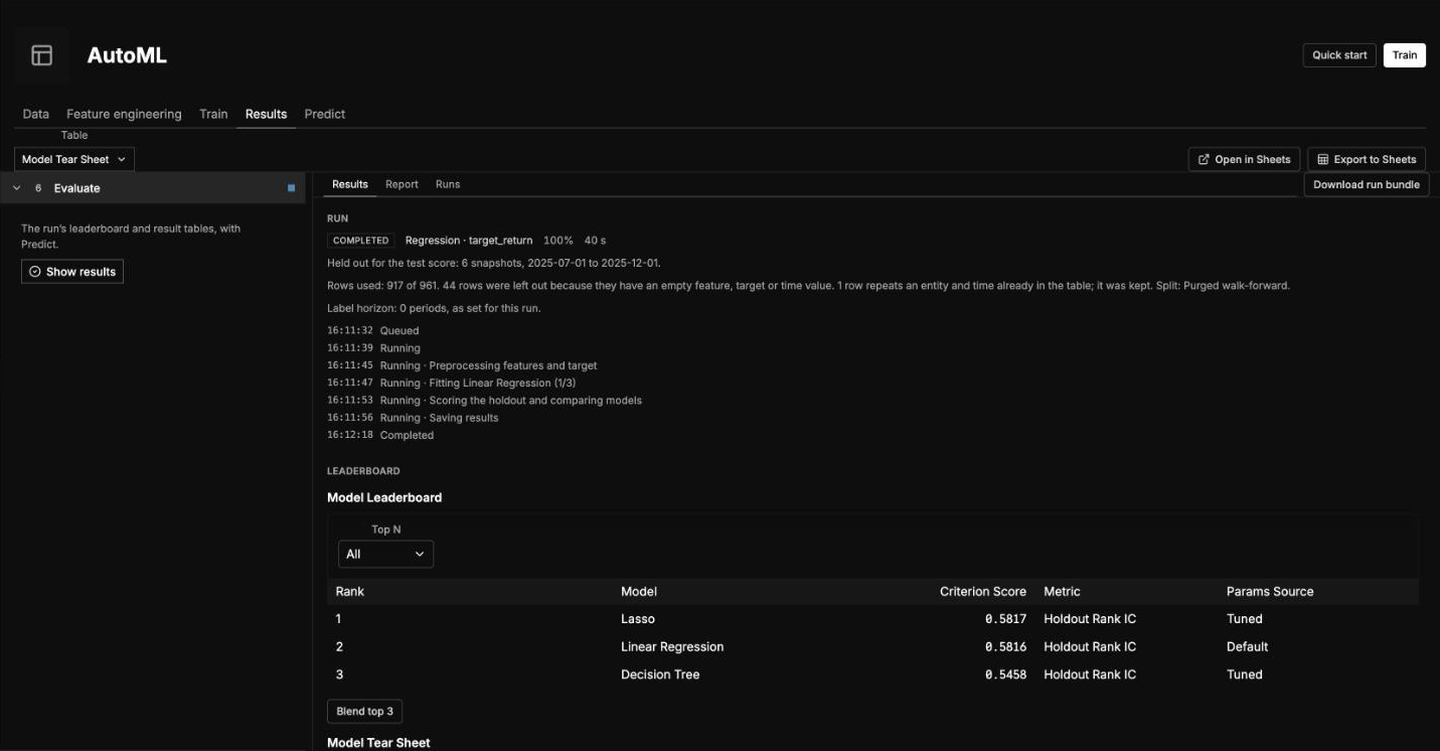
Completed regression run with training progress, a purged walk-forward split, holdout scores and a Blend top 3 button
Example regression run on demo data: progress, rows used and holdout scores.
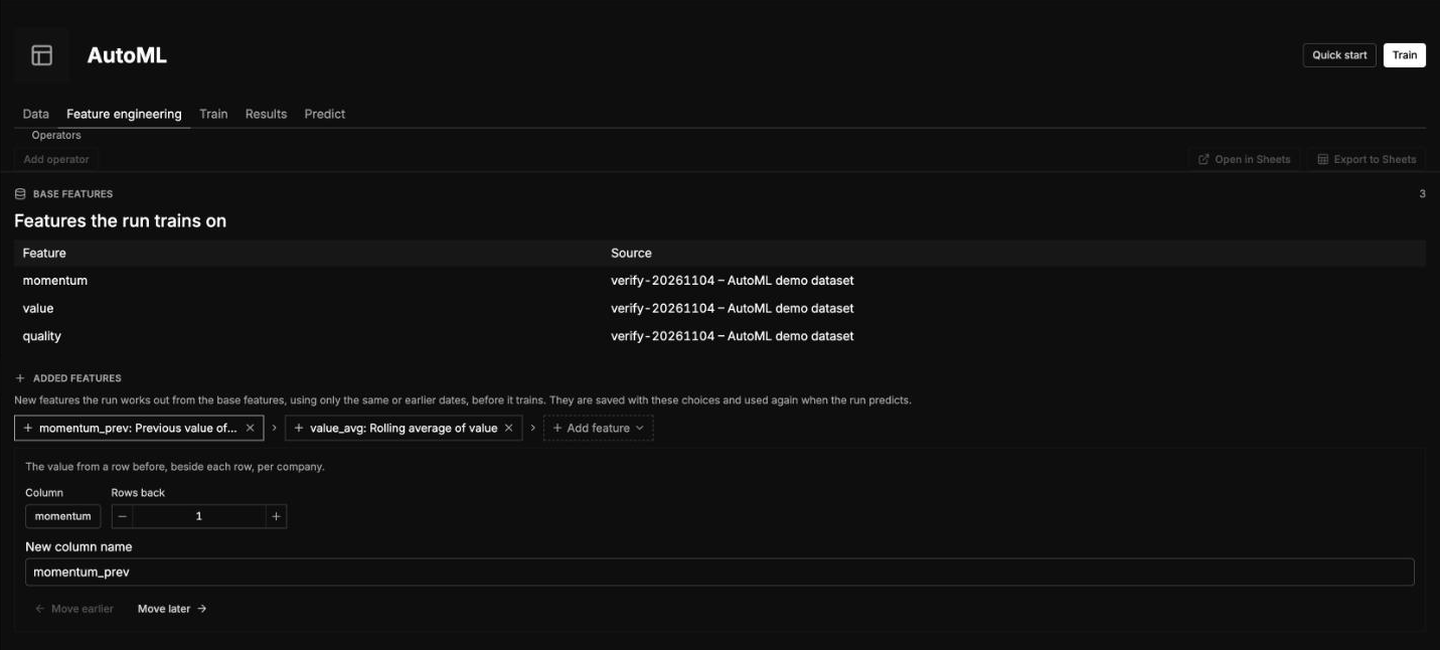
Feature editor adding a one-row momentum lag and a rolling average of value
The workbench saves lag and rolling feature definitions with the run and reapplies them when scoring.
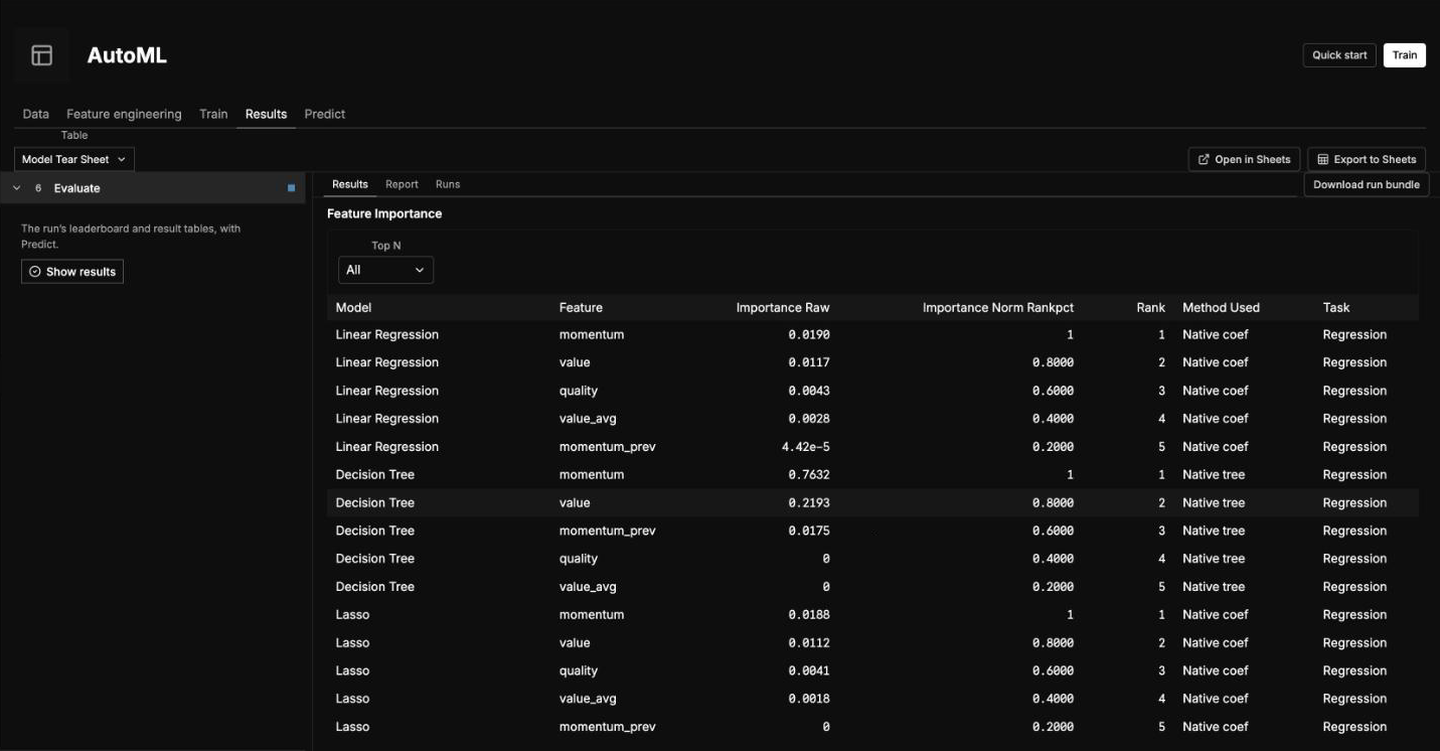
Feature importance table comparing linear regression, decision tree and lasso models
Feature importance, including engineered features.

Out-of-sample model comparison

  • For equity panels, purged walk-forward cross-validation removes training labels that overlap the test window. An embargo adds a gap, and a separate holdout spans multiple dates.
  • The equity leaderboard ranks supervised models by Rank IC IR across holdout dates.
  • Published tables use walk-forward splits when they have a time column and seeded K-fold otherwise, with grouping or stratification as appropriate. The table leaderboard uses R² for regression and balanced accuracy for classification.

Training, explanation and scoring

  • Both data sources support regression, classification and clustering. The equity panel also supports dimensionality reduction and similarity search.
  • Hyperparameter search runs within a trial budget, and supported boosting models use early stopping on a validation fold.
  • For supervised runs, researchers can inspect out-of-fold predictions and feature rankings, explain individual predictions with SHAP, and combine top models into an ensemble. Predict scores the latest or a historical equity snapshot, or queues a scoring job over a published table.
  • Oversized tables are refused explicitly, and published-table permissions are rechecked on read and export.

What the staging tests established

Staging tests checked engineered feature values and independently recalculated metrics. They also tested repeatability, cancellation and concurrent runs. A deliberately leaky feature served as a positive control for the leakage check.

The staged equity panel filtered historical data by current listing status, which introduces survivorship bias into historical tests.

Explore Factor Modeling